CFO Advisory | Finance Transformation

Finance Target Operating Model – The Evolution of the Finance Office

The CFO function has undergone a fundamental transformation: accountants have become analysts and business partners. Today, Finance funds business model transformations, enables new billing models, and provides reliable financial and nonfinancial data. A clear Finance Target Operating Model (Fin-TOM) aligns the organization to deliver on these priorities.

New requirements are reshaping the role of Finance.

The CFO organization has evolved over recent decades from a predominantly accounting-focused function into a strategic business partner. In companies with business models undergoing significant transformation, Finance must actively support this shift by funding new business models, designing new billing models, and providing reliable information. As one of the few functions able to report consistently across global corporate structures, the CFO organization is increasingly taking responsibility for nonfinancial data. Ongoing digitalization and the growing importance of data-driven decision-making are changing the requirements for processes, capabilities, technology, and organizational structures.


Drivers

When does the Finance organization need to be realigned?

  1. Business and billing models are changing

    Business model transformation creates new demands on the CFO and the Finance organization. Finance must fund this transformation and make new billing models operationally viable.

  2. Complex organizational structures make financial steering more difficult

    Decentralized structures can create complexity and inconsistent reporting data. The Finance organization needs to reassess its operating model to improve effectiveness and efficiency.

  3. Expectations for data and reporting are rising

    Financial and nonfinancial data are becoming increasingly important. At the same time, expectations for forecasting, data analytics, and data-driven compensation models are rising.

  4. Digitalization and AI are transforming finance processes

    Digital technologies create new opportunities to use data and automate finance processes. AI is becoming increasingly important as a lever for improving efficiency.

  5. Finance’s evolving role requires new capabilities

    The CFO organization is moving beyond traditional accounting tasks toward strategic and analytical functions. This increases the need for expertise in statistics, econometrics, and data analytics.

  6. Demographic change is increasing the pressure to act

    An aging workforce and the limited appeal of traditional roles are intensifying talent shortages and may reduce the efficiency of the Finance organization.

Finance Target Operating Model at a glance

Is your Finance organization fit for the future?

Digital business models, fragmented system landscapes, and increasing automation are fundamentally changing what Finance needs to deliver.

Our video explores why traditional structures are reaching their limits, how roles and responsibilities are evolving, and why a clearly defined Target Operating Model matters.


This is an embedded YouTube video which is activated by clicking the play button.

Finance Target Operating Model

A clear target vision for the Finance organization.

Finance Target Operating Model

The Finance Target Operating Model (Fin-TOM) provides a strategic framework for transforming and realigning the Finance function.

It reflects the changing role of the CFO and the CFO organization: moving beyond traditional accounting activities toward strategic, analytical, and data-driven functions.

The focus is on how finance processes, organizational structures, capabilities, and technology can be developed to improve the performance of the Finance function and support innovative business models.

Without a clear vision for the future Finance organization, the CFO function risks becoming the dinosaur of the company!

Stephan Grunwald | CFO Advisory
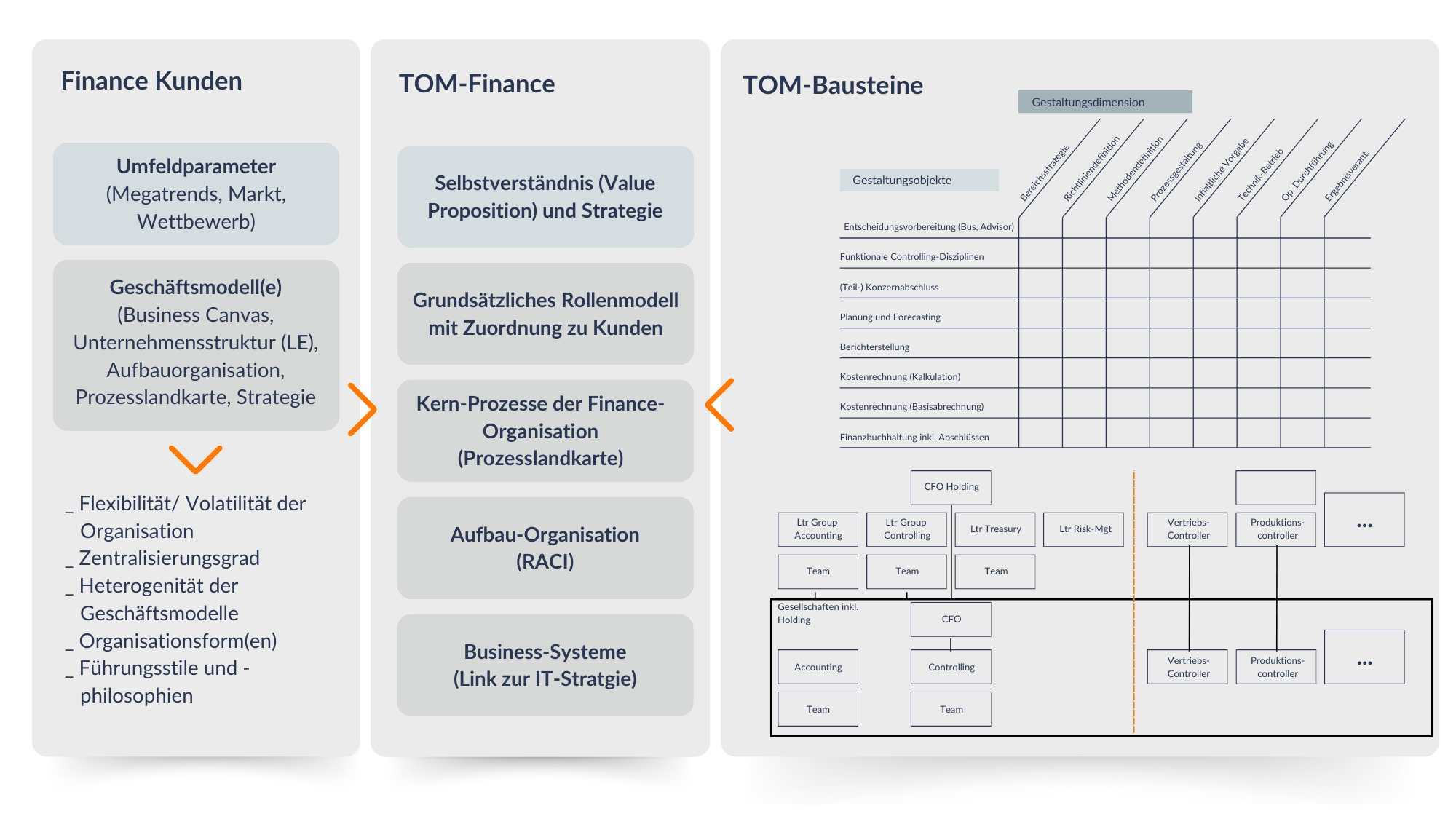
Finance Target Operating Model with Finance customers, Finance TOM, and TOM components

Five success factors for an effective Finance TOM

  1. Clear vision

    A clearly defined target vision for the future role and direction of the Finance organization.

  2. Technology integration

    The targeted use of modern technologies to support and further develop finance processes.

  3. Data capabilities

    Developing the capabilities required in statistics and data analytics.

  4. Process optimization

    Standardizing and automating processes to improve efficiency and effectiveness.

  5. Change management

    Effectively managing organizational change and supporting the transition.

Finance Target Operating Model with Finance customers, Finance TOM, and TOM components

Your benefits

What an optimized Finance Target Operating Model can deliver.

A clearly defined Fin-TOM helps organizations continuously improve the performance of their Finance function.

Five benefits at a glance

  1. Greater efficiency and lower costs

    Automating and optimizing finance processes helps organizations use resources more effectively and reduce costs.

  2. Better-informed decisions

    Integrating advanced data analytics provides deeper insights and strengthens the basis for strategic decision-making.

  3. Flexibility and scalability

    An adaptable Fin-TOM enables the Finance organization to respond to market changes and seize opportunities for growth.

  4. Improved risk management

    Improved data processing and analysis make it easier to identify and manage risks effectively.

  5. A stronger strategic role for the CFO

    A clearly defined Fin-TOM enables the CFO organization to create value beyond its traditional finance responsibilities and contribute to corporate strategy.

Our approach

From analysis to a future-ready Finance Operating Model.

Transforming the Finance organization requires a clear target vision, changes to processes and structures, and consistent implementation.

Our approach comprises five steps.

  1. Analysis & vision

    Identifying current challenges and defining a clear vision for the future Finance organization.

  2. Adapt processes and organizational structures

    Reviewing internal processes and the organizational setup to improve the Finance function’s efficiency and effectiveness.

  3. Redefine roles and services

    Realigning the Finance organization’s functions, roles, and services with changing requirements.

  4. Develop a business-IT strategy

    Developing a clear strategy for deploying IT resources to make the most of data in the digital economy.

  5. Implement and continuously optimize measures

    Implementing the defined measures and continuously evaluating and adapting the operating model to a changing business environment.

Praxisbeispiele · CFO Advisory

Finance Transformation in der Praxis.

Client

Viessmann

A New Direction for Finance Governance

Case Study

From Legacy Complexity to Clear Finance Governance

Target Operating Model · Digital Roadmap

How Viessmann gained transparency into its structures and priorities for action—and used these insights to develop a roadmap for advancing its Finance function.

View case study

Your experts

Let’s talk about your priorities

FAQ

Frequently asked questions about the evolution of the Finance organization

We begin by assessing current challenges and defining a clear vision for the future Finance organization. We then align processes, organizational structures, roles, and services with evolving requirements.
New business models are changing the demands placed on the Finance organization. A Finance Target Operating Model helps align processes, roles, services, and technology so that Finance can effectively support business transformation.
As financial and nonfinancial data grow in importance, so do the demands on the Finance organization. Key priorities include developing expertise in statistics and data analytics and using modern technologies strategically to support finance processes.
Our approach comprises five steps: assessing current challenges and defining a vision; adapting processes and organizational structures; redefining roles and services; developing a business-IT strategy; and implementing and continuously optimizing the measures.
Standardizing, automating, and optimizing finance processes enables more effective use of resources and reduces costs. At the same time, realigning roles and services helps the CFO organization evolve into a strategic business partner.

Are you looking to align your Finance organization with new business models, reliable data, and a stronger business partnering role? Together, we’ll develop a Finance Target Operating Model tailored to your needs and define concrete next steps.

Prioritäten besprechen

Weitere Themen

Finance & Controlling ganzheitlich betrachten.

Unsere CFO Advisory

Recognized

Best Management Consultants 2026

Recognized by our clients and partners

brand eins Thema Beste Unternehmensberater 2026

Your non-binding enquiry

We appreciate your message and will get back to you promptly. You can find information about data processing in our data protection notice.

Submit a non-binding inquiry
Contact us for a non-binding discussion and tell us about your concerns.