
Decisions lose speed and quality
Incomplete information and unclear decision rights delay critical decisions. Their implications for other parts of the transformation often receive too little consideration.

Transformation Excellence
4C GROUP creates the conditions for complex transformation initiatives to stay focused on a clear objective—even in uncertain environments—and become embedded in day-to-day operations.
Complex transformations involve multiple interdependencies. Conditions evolve, and critical decisions often need to be made under uncertainty. Transformation Governance provides an overarching framework to steer change. It sets clear priorities and enables targeted course corrections when execution moves off track.
Risk areas
When governance becomes the bottleneck
As transformations grow in scale and pace, effective governance becomes more demanding. Six risk areas frequently emerge.
Incomplete information and unclear decision rights delay critical decisions. Their implications for other parts of the transformation often receive too little consideration.

Critical expertise and core governance responsibilities are concentrated in a few key individuals who also manage project delivery and day-to-day operations. Workloads increase, as does reliance on individual availability.

As initiatives and dependencies multiply, maintaining an overview becomes harder. Functions focus on their own priorities, while conflicting objectives and cross-functional implications fall out of view.

New requirements and changing priorities repeatedly reopen fundamental questions. Without a shared target state, governance loses its ability to provide clear, consistent direction.

When project teams and business functions pursue different priorities, friction increases. Change moves forward within the project but remains difficult to embed in the organization.

New structures, processes, and ways of working must take hold while the business continues to perform. Without adequate preparation for the transition, core processes and intended outcomes are put at risk.
Our approach
Transformation Governance is not a one-size-fits-all model. The governance required depends on the starting point, the urgency to act, and the available scope for action. We combine an assessment of the transformation context with a clear view of all relevant transformation areas and governance that extends through implementation.
Assess the starting point
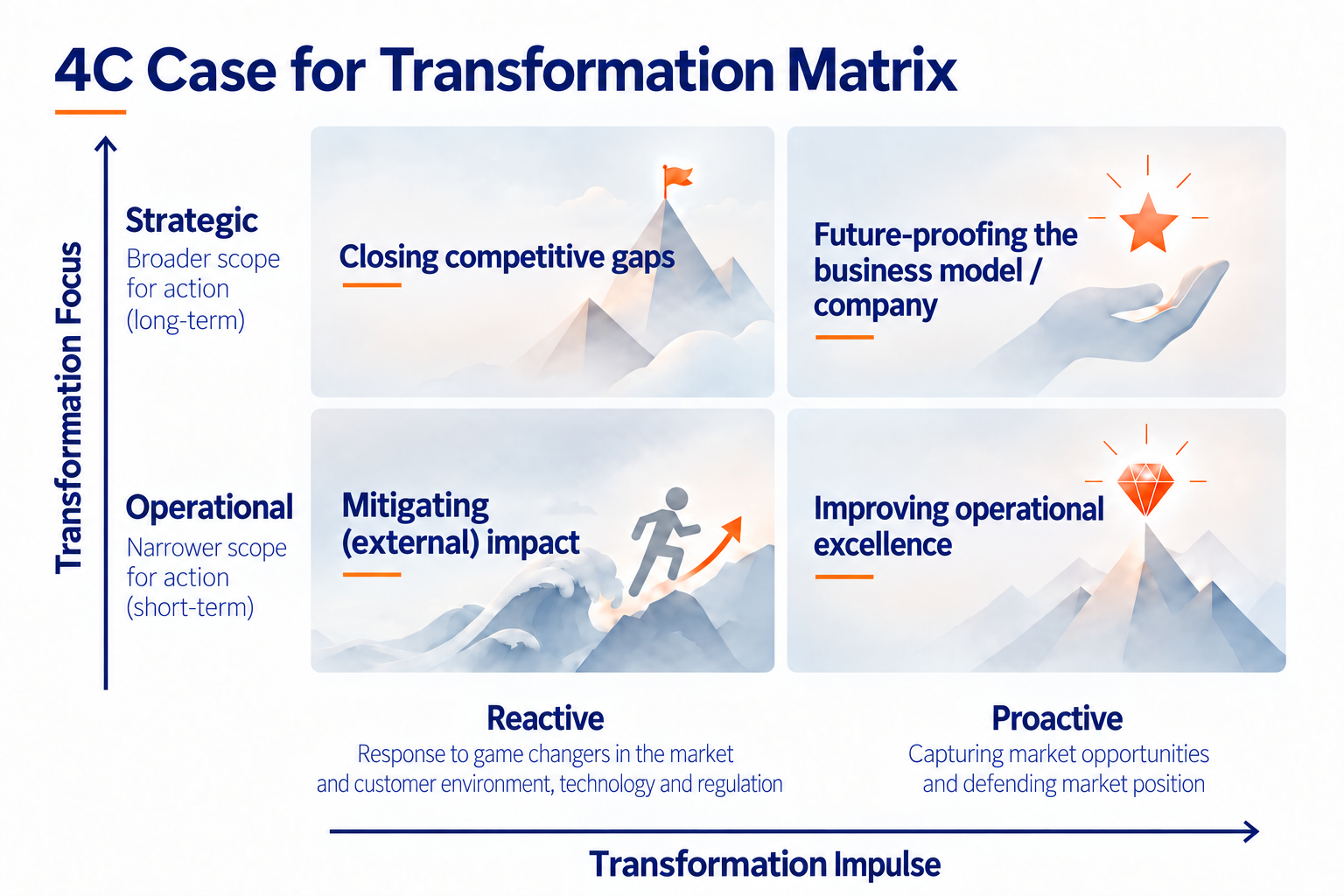
Every transformation starts with its specific business context. The 4C Case for Transformation Matrix maps that context across two dimensions: transformation focus and transformation driver.
The matrix distinguishes between strategic and operational transformations, as well as reactive and proactive situations. It clarifies whether the priority is closing competitive gaps, securing the future of the business model or company, mitigating external impacts, or improving operational excellence. The assessment also identifies the available scope for action. This provides the basis for defining governance requirements, the level of management attention needed, and the approach to steering the transformation.
Assessment dimensions
Select an area to learn more.
Is the mandate for change clearly defined and aligned across management?
The Case for Transformation clarifies why change is needed, the urgency to act, and the intended direction. Throughout the transformation, we assess whether this foundation remains valid as conditions change or needs to be adjusted.
Is it clear how the transformation will be directed and led?
This checkpoint assesses whether the target state, strategic direction, and approach to change are sufficiently clear to guide leadership and governance consistently.
Is implementation planned realistically, with a clear basis for managing delivery?
Initiatives, dependencies, responsibilities, and resources must be defined in enough detail to translate the target state into an actionable implementation plan.
Is the transformation delivering its intended impact?
Throughout implementation, we assess whether the expected outcomes are being achieved and embedded sustainably. Deviations provide the basis for targeted corrective action.
Make interdependencies visible
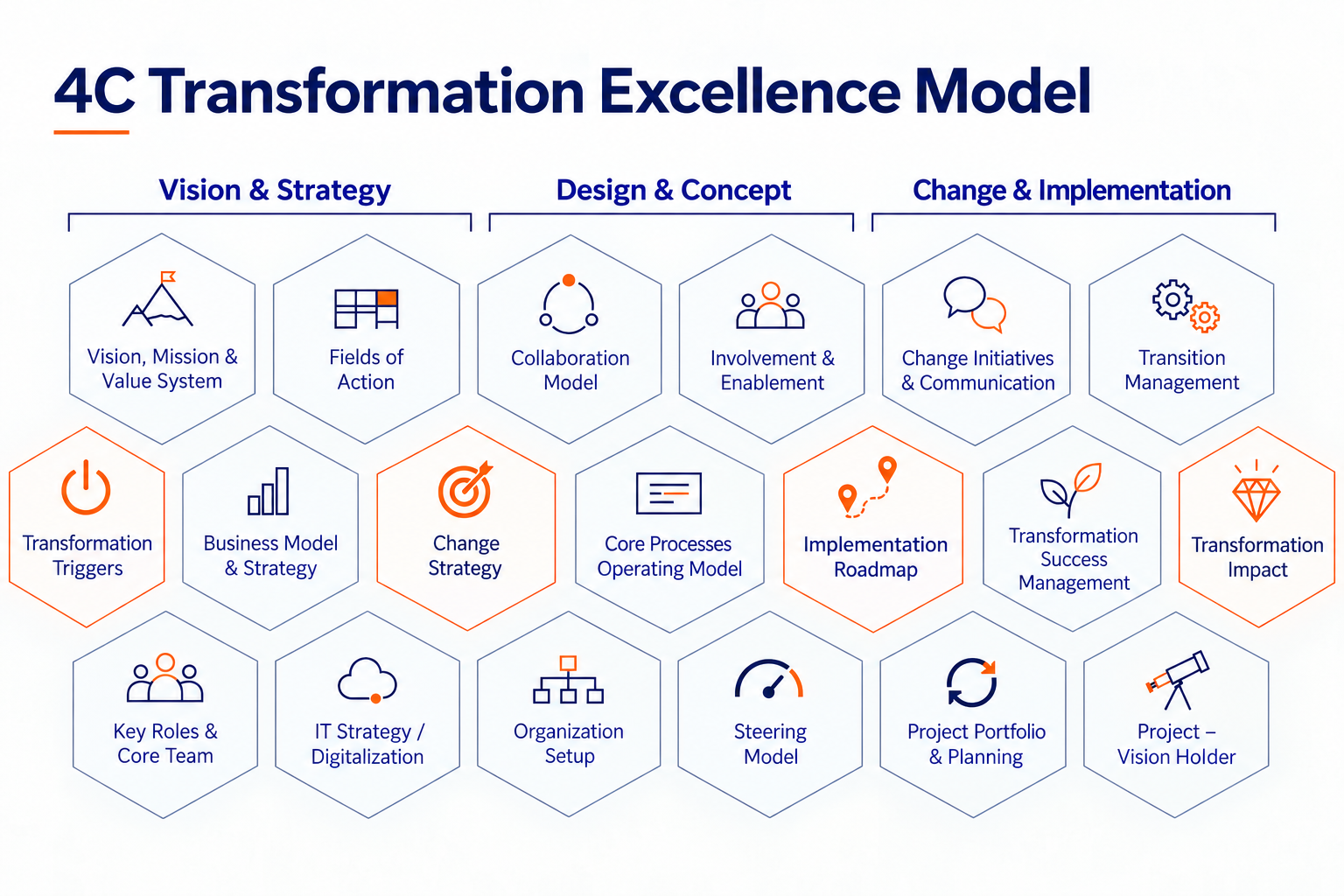
Transformations affect multiple areas of a business. The 4C Transformation Excellence Model makes the interactions between these areas visible.
Changes to organizational structures or processes can create new requirements for technology, collaboration, or leadership. The model provides a shared frame of reference for Transformation Governance: decisions can be assessed for their impact on other transformation areas, dependencies become visible early, and necessary adjustments can be coordinated across the business. This keeps the overall transformation in view, even when individual topics are being addressed in parallel and with different levels of intensity.
Transformation areas span
Actively manage execution
A robust roadmap provides the foundation for implementation, but it is not enough on its own. Assumptions, dependencies, and priorities change as the transformation progresses. With Smart PMO, we create transparency into the transformation's actual status and focus governance on the decisions needed to move execution forward.
We make progress, risks, and dependencies visible, prepare escalations, and coordinate corrective action. At the same time, we support the transition to business-as-usual operations and help embed new governance practices and ways of working across the organization. Our contribution does not end with the concept and roadmap. It extends through operational implementation.
From roadmap to execution: 4C stays actively involved in steering your transformation.
Our impact
Transformation Governance enables management to act decisively as conditions change and turn plans into reliable execution.
The target state, implementation plan, and budget remain aligned and realistic within the prevailing business conditions.
Management attention and resources are directed toward the issues that matter most for transformation success.
Risks are identified and addressed early, before they disrupt the transformation's progress.
Decisions are based on sound information, and initiatives are assessed against the outcomes they are intended to deliver.
Deviations become visible early, enabling management to adjust course in time and intervene where needed.
Affected functions are prepared for change, and implementation is supported through to day-to-day operations.
When realities change,
experience and conviction make the difference.
driving Transformation
We combine specialist expertise with extensive transformation experience. As a peer-level sparring partner, we challenge critical decisions and make conflicting objectives and their consequences transparent.
We temporarily take on transformation management responsibilities when leadership capacity is stretched. This maintains continuity and keeps the transformation moving, even when resources are constrained.
We coordinate initiatives, responsibilities, and dependencies across business functions. Management retains sight of the bigger picture and remains able to steer the transformation.
We work closely with affected functions and equip leaders and employees to implement change themselves. This strengthens ownership and embeds change in day-to-day operations.
We involve business functions early and prepare the transition to business-as-usual operations. In doing so, we protect critical business processes and help secure the transformation’s expected benefits.
“Transformation rarely fails because of the what. It fails because of the how. We take responsibility to make sure it does not.”
Hans-Martin Schneider · Senior Partner · 4C GROUP

Strategic Realignment & Transformation

Business Transformation & Governance
Transformation Governance establishes the overarching framework for steering complex change initiatives. Traditional project management primarily organizes the planning, progress, and resources of individual projects. Transformation Governance also defines decision rights, accountability, escalation mechanisms, and how management, project teams, and business functions work together. This enables organizations to manage cross-functional dependencies and conflicting objectives.
Dedicated Transformation Governance becomes particularly important when multiple initiatives and dependencies must be managed simultaneously, objectives or business conditions change, or decisions affect several business functions. Other indicators include unclear decision rights, heavy reliance on a few key individuals, competing priorities between project teams and business functions, or a critical transition to business-as-usual operations.
The starting point is the specific Case for Transformation. It clarifies the urgency to act, the intended direction, and the depth of change across the business. Based on this assessment, decision-making structures, responsibilities, escalation mechanisms, and governance requirements are defined. As requirements can change during implementation, governance must also be reviewed and adapted when necessary.
The 4C Transformation Excellence Model provides a shared frame of reference for the transformation. It structures the relevant transformation areas across Vision & Strategy, Concept & Design, and Change & Implementation, making their interactions visible. Four validation checkpoints—transformation driver, change strategy, implementation roadmap, and transformation impact—support ongoing reviews of direction, feasibility, and outcomes.
A Smart PMO translates governance into the day-to-day management of execution. It creates transparency into progress, risks, and dependencies, prepares management decisions and escalations, and coordinates corrective action. It also supports the transition to business-as-usual operations, helping embed new structures, processes, and ways of working across the organization.
In an initial conversation, we clarify where your transformation needs stronger governance—whether in decision-making structures, accountability, dependencies, management visibility, or the transition to business-as-usual operations. Together, we identify the right starting point and define the next steps.
We support your Transformation.
Contact us now!
Recognized
Recognized by our clients and partners
](https://www.4cgroup.com/media/transgovern_transition.jpg]\(https://www.4cgroup.com/media/transgovern_transition.jpg\)))