4C Insights

Patrick Utsch

Patrick Utsch

Partner | CEO Advisory
8 min. May 2026

Turnaround Before It Becomes Critical

A CEO’s Guide to Performance Revitalization — why turnaround management starts earlier than many companies assume.

At first glance, everything appears stable. Order intake is solid, the organization is operating at full capacity, and day-to-day business is running smoothly. Yet the environment around the company continues to change: customer expectations shift, new technologies challenge established offerings, and price pressure increases. Over time, these developments begin to affect the business itself, and profitability starts to decline even though utilization remains high.
This is where the real risk emerges. Companies that overlook the warning signs or ignore them for too long lose room to act. When they eventually respond, they face greater pressure, higher risks, and fewer options.

This article explains why turnaround management starts earlier than is commonly assumed. It examines typical patterns in the run-up to a crisis, identifies specific warning signs, and shows why turnaround management should be understood as a deliberate leadership decision to secure the company’s future.

Key Takeaways

The most important insights

01 A turnaround starts before a visible crisis emerges. The critical phase often begins while the company is still operating at high capacity, even as profitability, momentum, and strategic flexibility are already declining.
02 The warning signs appear in day-to-day operations. Slowing growth, high activity with limited results, and decision bottlenecks at senior-management level can all point to deeper structural problems.
03 In a turnaround, focus matters more than breadth. Success depends on concentrating on a small number of levers that materially improve performance, management control, and operational effectiveness.
04 Decisions often have to be made before every uncertainty has been resolved. This requires clear accountability at senior-management level, well-defined priorities, and implementation that is supported throughout the organization.
05 A turnaround also creates an opportunity for realignment. Companies that use this phase well can stabilize the business and lay the foundations for sustainable development.

01Starting Point

Turnaround Does Not Mean Crisis. It Means Acting Early.

For many companies, insolvency appears to be a sudden event. In reality, it is usually the outcome of a development that began much earlier. Insolvencies are the visible result of structural change rather than its cause. Companies can be affected long before the consequences become apparent in their financial figures. That is what makes the situation difficult to assess. As long as operations continue to function, it is easy to assume that there is still enough time to adjust. Decisions are postponed, and necessary changes are delayed. By the time the crisis becomes visible, many options have already disappeared. Measures then have to be implemented quickly, often with deeper intervention and considerably higher risk. Companies need to act before they reach that point. Early action allows management to make decisions from a position of relative stability. Priorities can be set more clearly, and the organization retains its ability to act.

This is why the conventional understanding of turnaround management is too narrow. The term is often used only when performance collapses, liquidity becomes tight, or restructuring measures are already required. In practice, turnaround starts earlier. It begins while the business is still functioning, but the conditions surrounding it are already changing in ways that threaten future performance.
In this context, turnaround management is neither a restructuring exercise nor a short-term cost-cutting program. It is a targeted realignment designed to secure financial stability and preserve the company’s long-term viability.


02Diagnosis

The Invisible Erosion: Why Companies React Too Late

A critical situation rarely stems from a single trigger. It usually develops through the interaction of external change and internal structures that fail to respond quickly enough.

External forces

The conditions surrounding a company often change before the organization fully recognizes what is happening. These developments do not necessarily cause a crisis on their own. They become critical when the company identifies them too late or fails to respond with sufficient urgency.

Product and innovation cycles are shortening, while technological developments reshape existing offerings and make previously successful solutions obsolete. As a result, business models lose relevance faster than they did only a few years ago. At the same time, costs become more volatile, more capital is tied up in the business, and margins come under pressure even when utilization remains stable. Product portfolios may also become less attractive as technologies evolve and customer expectations change.

Internal amplifiers

Inside the company, these external changes often meet structures that were designed for a different situation. Instead of absorbing the pressure, the organization amplifies it.

Decision-making processes are too slow to respond to new requirements. Responsibilities lack clarity, and governance structures make rapid prioritization difficult. Organizations may also be operating at full capacity without producing the expected results. This becomes particularly apparent during periods of growth. Revenue increases, while processes and organizational structures fail to scale at the same pace.

The “grey zone” before the crisis

A third factor is often underestimated: how companies perceive and interpret these developments.

Early warning signs are played down or treated as temporary fluctuations. Companies continue to rely on approaches that worked in the past, while management focuses on symptoms rather than the underlying causes. The transition from stability to crisis is therefore gradual. It is often perceived as sudden only once the company’s room to act has already narrowed significantly.

This creates a grey zone in which problems accumulate without being clearly identified or systematically addressed.


 

Turnaround Management

Most companies don't fail because they fail to see the trend—but because they misjudge it for too long.

Patrick Utsch

03Warning Signs

Three Warning Signs CEOs Need to Take Seriously

These developments often become visible in day-to-day operations long before they are recognized for what they are.

Growth is losing momentum

One of the first signs is often a loss of growth momentum. Utilization remains high, yet new orders become more difficult to win and sales cycles take longer. Externally, the figures may still look stable. Internally, however, it becomes increasingly clear that the company is beginning to lose ground in the market.

High activity, limited results

The organization is working at full capacity, but the expected progress fails to materialize. Orders take longer to complete, decisions are delayed, and results no longer justify the effort involved.

Decision bottlenecks at senior-management level

Another warning sign appears at the top of the organization. Decisions take longer, discussions go in circles, and priorities remain unclear. Issues are postponed or only partially resolved because management is uncertain about the right direction. The organization begins to stall. Initiatives lose momentum, and implementation falls short of expectations.


04Implementation

Success Factors in Turnaround

After the initial analysis, the direction is usually clear. The real challenge lies in implementation.

Speed

Speed is a central success factor in turnaround. The earlier the necessary steps are taken, the more freedom the company retains to shape the outcome.

  Fast, pragmatic analysis rather than months of concept development
  Early implementation of initial measures with visible results
  Clear focus on the most important levers
  Speed prioritized over perfection

Focus and prioritization

A turnaround cannot be managed successfully when too many initiatives are pursued at the same time. Management must identify the small number of issues that can make a meaningful difference.

  Concentration on measures with a strong impact on performance and liquidity
  Clear prioritization based on impact and feasibility
  Reduction of complexity rather than the addition of further programs
  Protection of the organization from overload

Leadership and governance

A turnaround quickly loses momentum without clear leadership. It requires unambiguous decisions and disciplined execution. Responsibility lies with senior management, which defines the direction, sets priorities, and establishes the pace.

  Active involvement of the CEO and CFO as decision-makers
  Clearly defined responsibilities and decision-making paths
  Robust governance to monitor progress and results
  Firm management commitment to implementing the agreed priorities

Culture and willingness to change

A turnaround always affects established structures and routines. Necessary changes will only take hold if they are accepted across the organization.

  Early and transparent communication of objectives and measures
  Clear orientation during a period of uncertainty
  Active involvement of the organization in implementation
  Trust built through transparency and reliable leadership
  Change embedded in day-to-day behavior

Holistic approach

Turnarounds often fail because individual areas are addressed in isolation. Sustainable results require the different elements to work together.

  Strategic realignment combined with operational improvement
  Business model, organization, and processes considered together
  All relevant stages of the value chain included
  Avoidance of isolated measures that fail to create overall impact

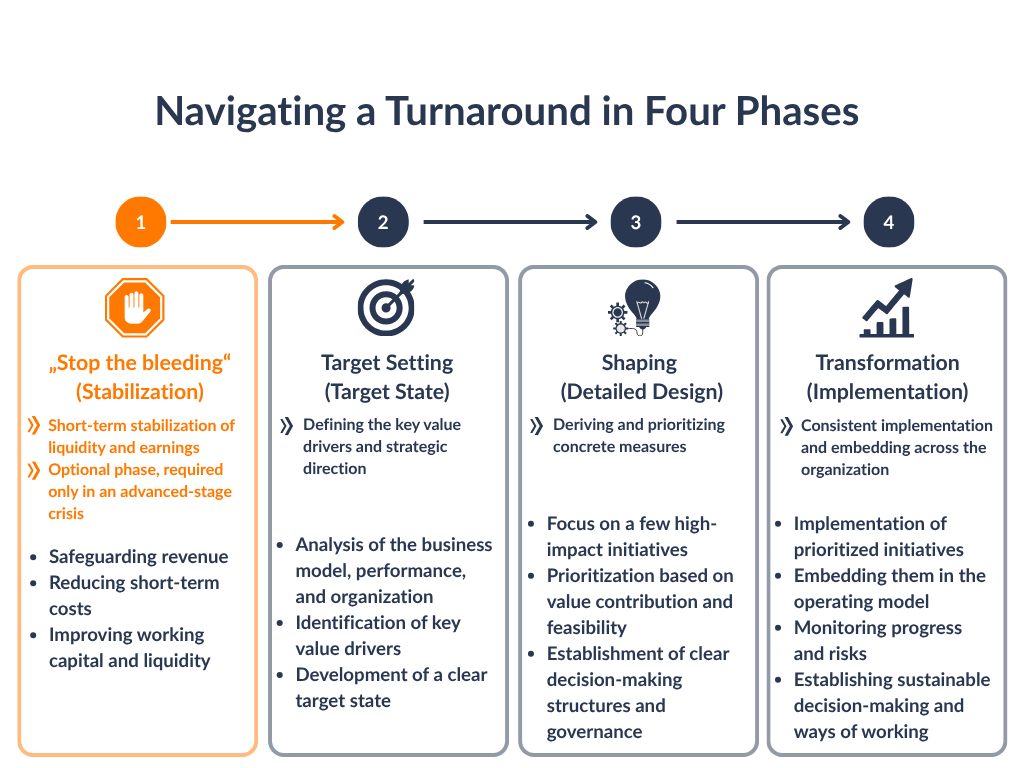
In practice, these factors do not follow a rigid sequence. They can, however, be structured into a number of typical phases.


05Alignment

Performance Revitalization: Where Turnaround Begins

A turnaround reaches beyond individual measures. It affects the business model, management systems, and operational processes at the same time. The company therefore needs a clear understanding of how these areas interact. Effective implementation becomes possible only when they are aligned.

Business model and market position

The first step is to assess whether the existing business model remains viable under the new conditions. This includes reassessing the market, the company’s offering, and the competitive landscape, as well as creating transparency around the key drivers of value and performance. This analysis provides the basis for a clear direction that secures financial stability and supports future growth.

Stabilization and steering

A turnaround also requires structures that enable fast decisions and effective implementation. Short-term stabilization and more far-reaching change need to reinforce one another. Protecting earnings and liquidity creates the room to act, while leadership, organizational structures, and management systems are realigned.

Operational performance

Day-to-day operations reveal whether the measures are making a genuine difference. This includes sharpening the product and service portfolio, improving customer-level profitability, and adapting processes to the current situation. Progress must remain measurable throughout.

Steering and implementation

The underlying principle remains the same across all areas: understand the interdependencies, set clear priorities, and manage implementation in a way that turns individual measures into a coherent path forward. Progress needs to remain visible, and deviations must be corrected early.


06Conclusion

Turnaround Begins With a Decision

A turnaround requires courage: the courage to recognize change early and realign the company while the pressure is still manageable. This means taking the initiative before circumstances leave no alternative and setting the necessary steps in motion.

A turnaround also requires clear decisions. Management must focus on the few issues that can materially change the company’s trajectory and embed them across the organization. This requires consistent priorities and the discipline to abandon measures that do not make a direct contribution. Decisions cannot always be fully validated in advance. They still have to be made, supported, and carried through.

A turnaround also depends on disciplined implementation. Progress must remain visible, deviations need to be addressed early, and insights must translate into concrete action. The agreed measures will only succeed if they become part of how the organization works every day.

A turnaround is more than a response to pressure. It is an opportunity to realign the company.

FAQ

Frequently Asked Questions About Turnaround Management

Answers to key questions about early warning signs, prioritization, and successful turnaround implementation.

When does a turnaround really begin?

A turnaround begins much earlier than many companies assume. The critical phase often starts while day-to-day business is still running smoothly, even though market conditions and business performance are already beginning to change. At this stage, management can still make decisions from a position of relative stability.

What are the early warning signs that indicate the need for a turnaround?

Typical warning signs appear in day-to-day operations. Slowing growth, high activity with limited results, and increasing decision bottlenecks at senior-management level often indicate that structural problems are beginning to emerge. Declining margins, longer sales cycles, and unclear priorities may also be early indicators.

Why do companies often react too late?

Many developments unfold gradually and are initially dismissed as temporary fluctuations. As long as operations appear stable, management often assumes there is still sufficient time to respond. As a result, important decisions are postponed while the company's room to act steadily diminishes.

How does a turnaround differ from a traditional transformation?

Transformations are typically launched from a position of stability and can often be implemented step by step. A turnaround, by contrast, takes place under greater pressure. Decisions have to be made more quickly, even though they cannot always be fully validated. The objective is to restore stability while repositioning the company for long-term success.

What role does senior management play in a turnaround?

A turnaround requires strong leadership. Senior management must set priorities, make decisions, and establish a clear direction—often before the need for action becomes obvious to everyone else. At the same time, leadership must create alignment across the organization and ensure disciplined execution.

Why do turnarounds fail despite clear action plans?

Turnarounds rarely fail because of a lack of ideas. They fail because implementation falls short. Too many parallel initiatives, unclear responsibilities, or weak prioritization prevent measures from delivering their intended impact. Success depends on disciplined execution and organization-wide commitment.

About the Author

Patrick Utsch

Partner

To profile


We support your Transformation.


Contact us now with no obligation
We appreciate your message and will get back to you promptly. You can find information about data processing in our data protection notice.

Inhalt

Inhaltsverzeichnis