
Start Your Expedition
Combating money laundering, terrorist financing, fraud and sanctions violations
Anti-money laundering and countering the financing of terrorism (AML/CFT) are at the heart of current regulatory developments in the EU. With the EU AML package, the EU is establishing a harmonised regulatory framework to strengthen anti-money laundering measures and standardise European supervision. In particular, the package comprises the recast of the Money Transfer Regulation, the new Anti-Money Laundering Regulation and Directive, and the AMLA Regulation establishing the European Anti-Money Laundering Authority (AMLA).
The Money Laundering Regulation establishes, for the first time, a directly applicable European rulebook (‘Single Rulebook') that harmonises regulatory requirements across Europe for the further combating of money laundering and terrorist financing. In addition, the requirements are further specified by Regulatory Technical Standards (RTS) and Implementing Technical Standards (ITS), which creates additional implementation needs in processes, data management and system landscapes.
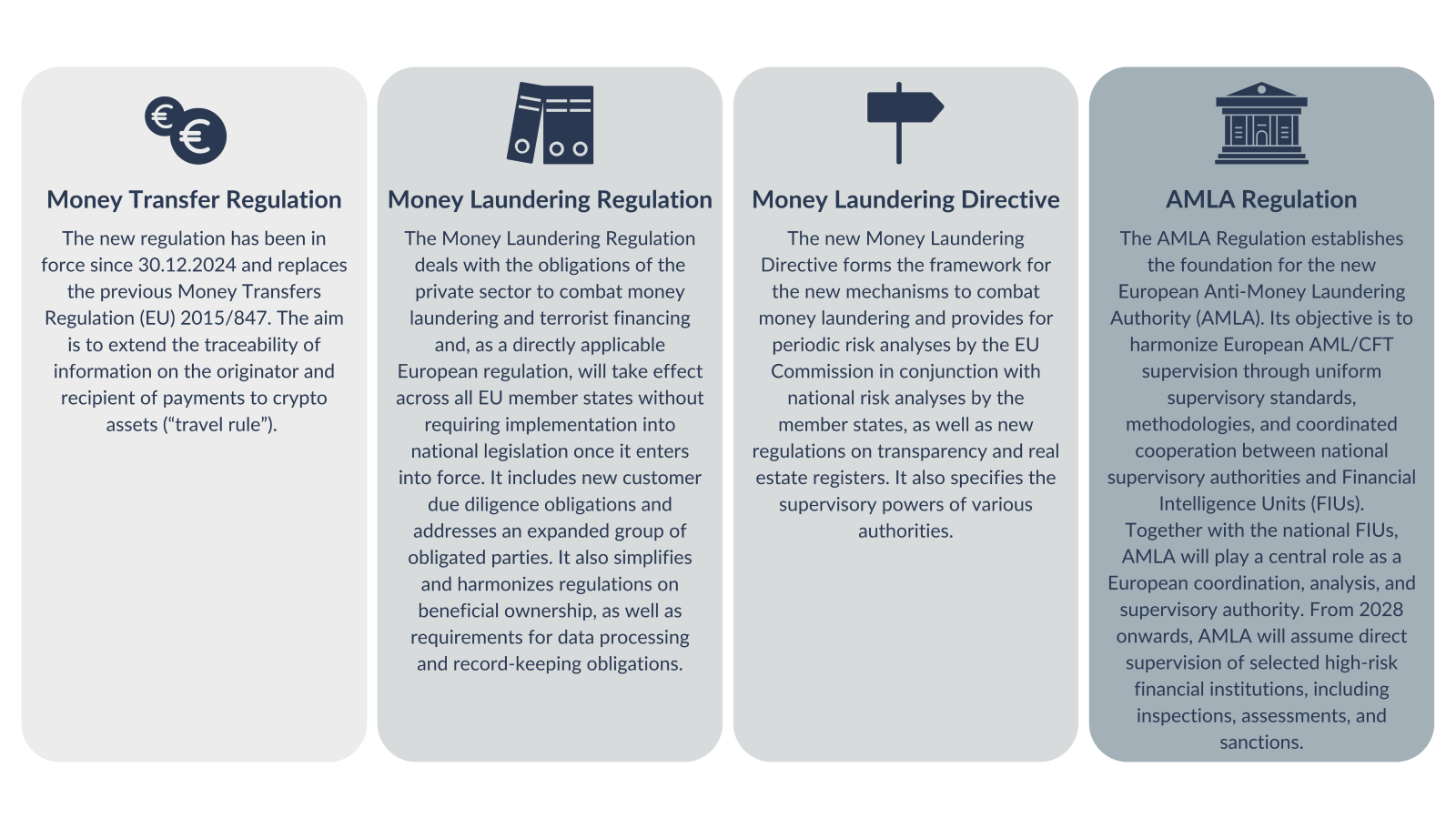
Key components of the EU AML package:
- Funds Transfer Regulation
- Money Laundering Regulation
- Money Laundering Directive
- AMLA Regulation
By 10 July 2027, the requirements of the Money Laundering Regulation must be fully implemented and the provisions of the Money Laundering Directive transposed into national law. It is crucial to act early to minimise legal risks and meet the new regulatory standards. This also offers an opportunity to increase operational efficiency and establish a robust compliance structure capable of meeting future requirements.
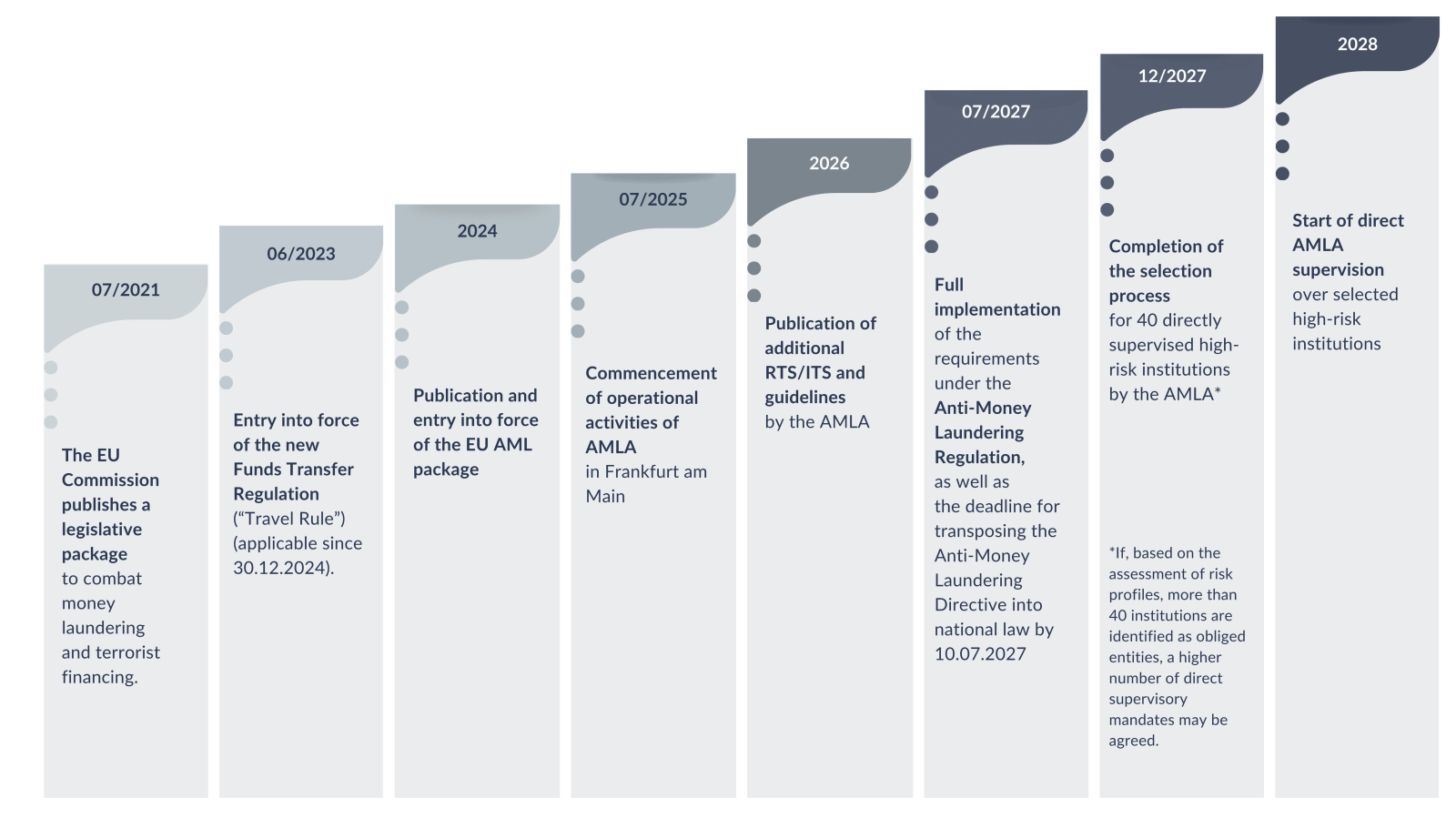
Obligations in Anti-Money Laundering Prevention
The obligations for anti-money laundering and counter-terrorism financing stem from various laws such as the Money Laundering Act (GwG), requiring transparency and security measures. A risk-based approach is central, obliging entities to have effective risk management and conduct risk analyses. This includes documenting, regularly reviewing, and updating risk analyses, as well as providing them to supervisory authorities. Internal security measures aim to control and mitigate risks, including developing principles, procedures, controls, and training employees.
Key Levers in Anti-Money Laundering Prevention
Our experience has shown that there are five key aspects in anti-money laundering prevention: employee reliability and expertise, supported by regular training, are crucial. Product design requires thorough assessment for money laundering susceptibility, especially for new products. Customer screenings and adjustments to the KYC process, along with regular reviews, can significantly reduce money laundering-related risks. Monitoring, filtering, and validating transactions, as well as investigating suspicious cases, require special attention, with new technologies enabling efficiency gains without increasing workload.
Success Factors
Efficient Regulatory Management
Conversely, it remains a common challenge for financial service providers to manage high manual processing efforts associated with numerous, inflexible legacy systems, redundant structures, and complex, dynamic regulations. By leveraging Lean Management and the adoption of new innovative technologies, these issues can be addressed, opening up new opportunities for effective and efficient Regulatory Management. Classical Lean Management aims to create value without waste, prioritizing customer orientation, highly efficient processes, and the pursuit of perfection. The use of cutting-edge technologies to support Regulatory Management functions (RegTech) leads to a relief of regulatory processes, increased efficiency, and heightened effectiveness.
Our Approach
How we support you
With our expertise and years of experience, we offer you targeted services for anti-money laundering projects. From customer onboarding and the KYC process to transaction monitoring and suspicious activity management, we enable you to successfully address your change needs. This also includes setting up and managing comprehensive initiatives such as awareness training for employees and executives. What do we never lose sight of? The focus on maximum effectiveness and efficiency of processes and structures.
- Determination of the relevant regulatory framework
- Recording of the current AML (Anti-Money Laundering) organization/strategy
- Identification and documentation of process clusters, process map
- Recording of existing reporting, control, and data management structures
- Business model-specific impact analysis
- Processing of existing information and analyses
- Analysis of procedural and process descriptions
- Systematic breakdown, modification, and documentation of all relevant process steps
- Prioritization and (project) planning of required action needs
- Conceptualization of the corresponding approach
- Operationalization across all transformation dimensions
More Topics
Your Experts




Feel free to contact us.
We would like to point out that this website only provides a limited insight into our services. Our expertise and range of services cannot be fully represented on this platform. For personalized advice and to address your specific concerns most effectively, we warmly invite you to contact us directly so that we can offer you tailor-made solutions.
Thank you for your trust. We look forward to hearing from you.